
Lumera Research: Cortisol Evidence Review
The Hormone Menopause Research Overlooked: 7 Things the Data Shows About Cortisol
From a 12-week placebo-controlled study of Tamisense-Q™ to what we still don't know.
★★★★★ 4.8 from customer ratings† · Trusted by 10,000 women nationwide
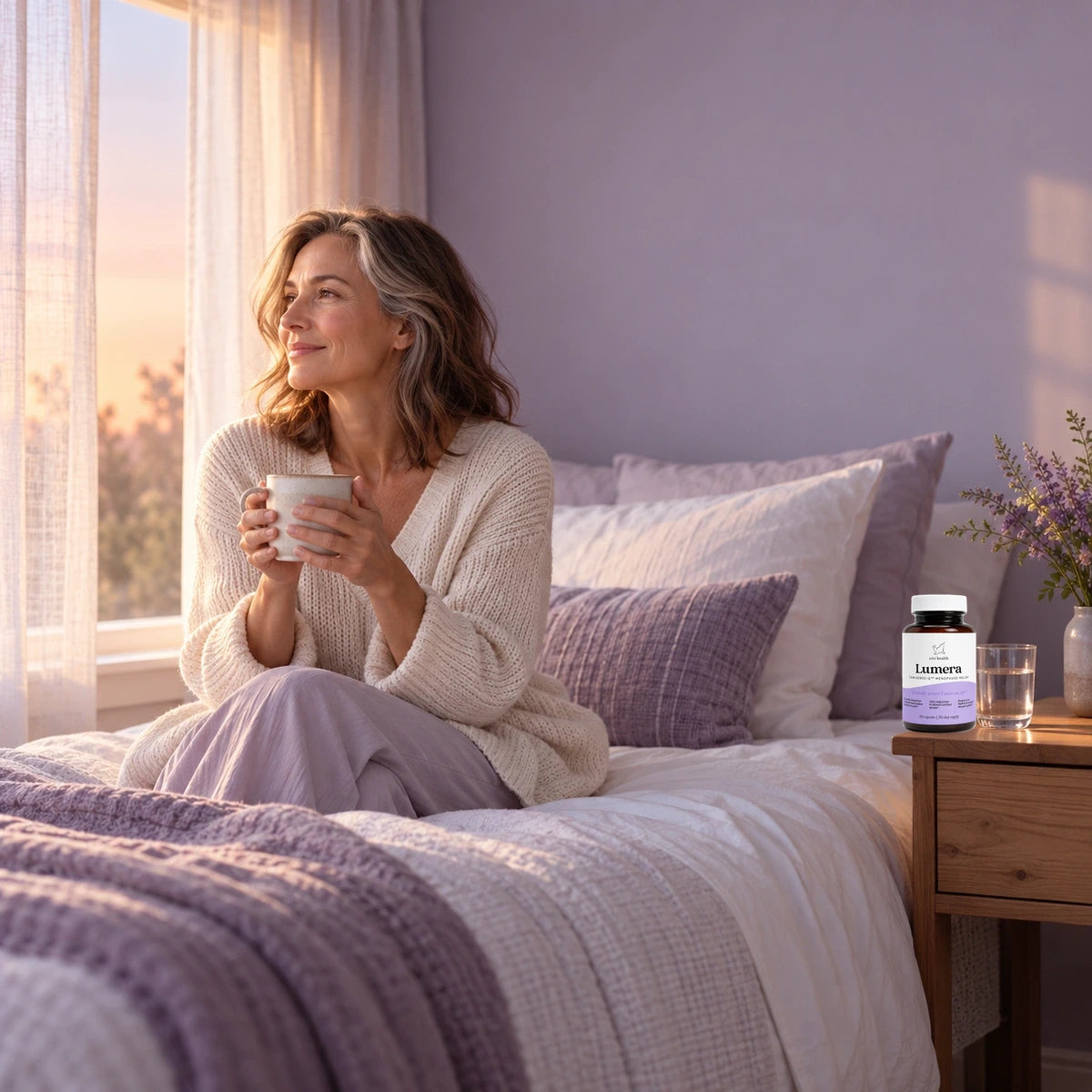
For a long time, the explanation women in their forties and fifties heard most often was some version of the same thing: it's stress, it's age, it's normal. Sleep breaks at 3am. Focus slips in the middle of a meeting. Patience runs out over small noises. Many women learn to push through it. Some learn to doubt themselves before anyone thinks to look more closely.
The research tells a more specific story. These changes are real, they often last for years, and some of them show up in lab measurements, not only in how a woman feels. Cortisol, the body's main stress hormone, is one of them, and it gets far less attention than estrogen.
Something real is happening in midlife. Much of it can be measured. A lot of it is still poorly understood.
This page collects what the published research shows, with sources, and is clear about what it doesn't show yet. Each finding has two boxes: what the data shows, and what we still don't know. At the end, we explain how we used one studied ingredient, Tamisense-Q™, in our formula.
The 7 findings
- 01Symptoms last years, not months
- 02Sleep breaks down most in late perimenopause
- 03Cortisol rises for some women in the late transition
- 04Most doctors aren't trained in this, and women pay for it at work
- 05One botanical complex has been tested against cortisol: Tamisense-Q™
- 06What the 300mg trial measured
- 07What it didn't change, and what's still unknown
Symptoms aren't a phase of a few months. For many women, they last years.
SWAN, the Study of Women's Health Across the Nation, followed 3,302 women in the US through the menopausal transition. Among the 1,449 women with frequent hot flashes or night sweats, the median duration was 7.4 years. For women who had a clear final period, symptoms continued for a median of 4.5 years after it.1
What the data shows
Median total duration of frequent hot flashes and night sweats, by group
SWAN, n = 1,449 women with frequent symptoms
Symptoms lasted longest in women whose symptoms started early, before or at the start of perimenopause. Higher perceived stress, anxiety and depressive symptoms were also linked to a longer duration.1
Source: Avis et al., JAMA Internal Medicine, 2015.What we still don't know
- Why duration varies so much from one woman to the next, and between groups.
- Whether the link with stress is a cause, a consequence, or both.
- The true total: the study notes duration may be underestimated, because some women still had symptoms when follow-up ended.
Sleep breaks down most in late perimenopause.
In a survey of 12,603 women aged 40 to 55 across seven US sites, 38% reported trouble sleeping in the past two weeks. The rate was highest in late perimenopause and after surgical menopause.2
What the data shows
Women reporting sleep difficulty in the past 2 weeks
Age-adjusted, n = 12,603
Cortisol follows a daily rhythm tied to the sleep–wake cycle, and that rhythm becomes more variable as women age.3 That's one reason researchers look at cortisol when sleep falls apart in midlife.
Source: Kravitz et al., Menopause, 2003; Woods et al., Menopause, 2009.What we still don't know
- Whether broken sleep raises cortisol, rising cortisol breaks sleep, or each feeds the other.
- How much 3am waking comes from night sweats and how much from something else.
Cortisol rises for some women in the late transition.
The Seattle Midlife Women's Health Study followed a group of women for fifteen years, from 1990 to 2005. In 132 women not using hormone therapy, researchers analyzed up to 5,218 overnight urine samples and related them to menstrual calendars, symptom diaries and hormone levels.3
What the data shows
Overnight cortisol rose as women moved from the early to the late stage of the menopausal transition, and rising cortisol was associated with more severe hot flashes.4
In the longer analysis, overnight cortisol moved with reproductive hormones (estrone, FSH and testosterone) and with the stress hormones adrenaline and noradrenaline (p < .0001).3 In other words, the ovarian system and the stress system don't change independently.
Source: Woods et al., Menopause, 2006 and 2009.What we still don't know
- Not every woman's cortisol rises. Once hormone levels were taken into account, menopause stage, symptoms and life stress had little relationship to overnight cortisol.3
- Whether lowering cortisol changes symptoms over the long term. That hasn't been studied beyond 12 weeks.
- Overnight urine is one way to measure cortisol. Blood, saliva and urine can give different pictures.
Most doctors aren't trained in this, and women pay for it at work.
If symptoms are this common and last this long, you might expect every doctor to be trained to recognize them. The data says otherwise.
What the data shows
OB/GYN residency program directors, 2023 survey
Published in Menopause, the journal of The Menopause Society
A Mayo Clinic study of 4,440 working women aged 45 to 60 found that 13.4% had at least one adverse work outcome because of menopause symptoms, and about 11% had missed work in the past year. The researchers estimated $1.8 billion a year in lost work time in the US, or $26.6 billion including medical costs.5
Source: The Menopause Society, 2023; Faubion et al., Mayo Clinic Proceedings, 2023.Behind those numbers is a familiar experience: women expected to keep working, parenting and caring for everyone else at the same level, through years of disrupted sleep and focus, often without a clear explanation. Not knowing what's happening becomes part of the burden.
What we still don't know
- How many women's symptoms go unrecognized, either because they never bring them up or because the symptoms are put down to something else.
- How much better outcomes would be with earlier recognition and support.
One botanical complex has been tested against cortisol in a placebo-controlled trial: Tamisense-Q™
Tamisense-Q™ is a complex of two plant extracts: Korean thistle (Cirsium japonicum var. maackii) and thyme (Thymus vulgaris). It was developed in South Korea, where researchers spent about 15 years screening natural substances for midlife women's health before settling on this combination.11 It's widely used by midlife women in South Korea but rarely found in US formulas.
What the data shows
2022 · J Med Food
The cortisol trial
- Women
- 71, aged 45+, pre-, peri- and postmenopausal
- Dose
- 300mg/day, double-blind
- Found
- Symptom scores −48%, quality of life +36%, blood cortisol −16%7
2016 · J Med Food
The dose comparison
- Women
- 30, middle-aged, three groups
- Dose
- 300mg or 500mg/day vs placebo
- Found
- Symptom scores −20% (300mg) and −40% (500mg); placebo no significant change8
2016 · J Korean Soc Food Sci Nutr
The symptom trial
- Women
- 62, mean age 55.4
- Dose
- 500mg/day
- Found
- Symptom scores −18%, vaginal dryness −21%, IGF-1 +10%9
2019 · J Funct Foods
The largest trial
- Women
- 142 (71 per group), mean age 54.9
- Dose
- 500mg/day
- Found
- Quality-of-life score 104.0 → 87.8 (p < .001); placebo 103.0 → 102.010
What the 300mg trial measured
The 2022 trial is the one that matters most here, because it used 300mg a day and measured cortisol directly. Seventy-one women were randomly assigned to Tamisense-Q™ or a placebo for 12 weeks. Neither they nor the researchers knew who got which.7
What the data shows
Improvement from baseline at week 12
Tamisense-Q™ 300mg/day vs placebo
Menopause symptom score (Kupperman Index)
Quality of life (MENQOL)
Psychological Well-Being Index
Blood cortisol
Endothelin-1, a blood-vessel marker
Cortisol, in the actual units
Mean ± SE: 7.03 ± 0.46 to 5.94 ± 0.47 (p < .05). The placebo group showed no reduction.7
All 12 symptoms on the index improved
Every one of the 12 symptoms scored by the Kupperman Index fell significantly in the Tamisense-Q™ group compared with placebo (p < .05):7
When the changes appeared
- Week 4Symptom scores were already about 31% better than baseline, against about 3% for placebo.7
- Week 12Improvement reached about 48%. Cortisol, well-being and quality of life were measured here.7
- After week 12Not studied. No trial has followed women beyond 12 weeks.
What it didn't change, and what's still unknown
Showing a result is only half of good science. The other half is saying what didn't happen and where the evidence stops.
What didn't change
In the 300mg trial, levels of the sex hormones estradiol, progesterone, FSH and LH showed no significant change compared with placebo. Neither did liver enzymes (AST, ALT), creatinine, bilirubin, blood pressure or body weight (p > .05).7
Tamisense-Q™ contains no hormones, and in this trial it didn't measurably shift hormone levels.What we still don't know
- Independent replication. All four trials came from the same Korean research group that developed the ingredient. Trials by unrelated teams would strengthen the evidence.
- Other populations. The participants were Korean women. Results may differ elsewhere.
- Long-term effects. Each trial lasted 12 weeks.
- Exactly how it works. Cell and animal studies suggest it may support estrogen-receptor activity when estrogen is low.11 That hasn't been confirmed in people, and the pathway behind the cortisol change hasn't been explained.
- Finished products. The studies tested the ingredient on its own, not Lumera or any other finished formula.
Lumera: built around the dose that was studied
We built Lumera around the 2022 cortisol trial. Each daily serving has 300mg of Tamisense-Q™, the same amount used in the study, plus supporting nutrients at printed doses. No proprietary blends, and no hormones.
| Tamisense-Q™Korean thistle + thyme complex · matches the 2022 trial dose | 300 mg |
| Cholineas VitaCholine® | 300 mg |
| Magnesiumas Albion® chelate | 50 mg |
| Vitamin D3vegan | 1,000 IU |
| Vitamin K2as MK-7 | 100 mcg |
| Folateas active 5-MTHF | 400 mcg DFE |
Take 2 capsules daily with food. Every trial ran 12 weeks, so judge it over 12 weeks. That's why every order has a 90-day money-back guarantee.
What women tell us
“The hot flashes aren't completely gone, but they're maybe half as bad and half as often. I'm sleeping through the night most nights now. It took about a month to really notice.”
Diane K., Lumera customer“I ordered Lumera expecting to return it. Around week 3, I realized I hadn't snapped at my husband in days. The brain fog that made me feel stupid in meetings? Lifting.”
Sarah M., Lumera customer“My doctor said it was perimenopause. I didn't want to go on hormones, so I tried Lumera. The fatigue is so much better. I have energy past 3pm now.”
Jennifer R., Lumera customerShared with permission. Individual results vary.
Give it the same 12 weeks the research did
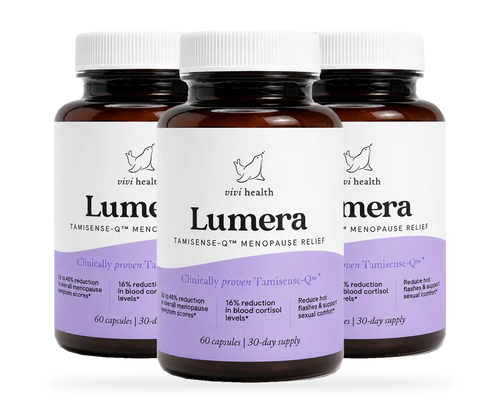
3 Bottles
Full 12-week program · $59/bottle
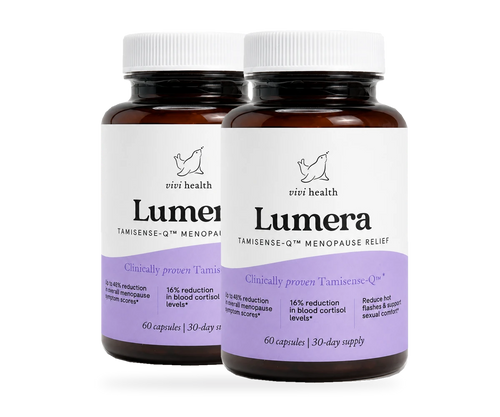
2 Bottles
8-week supply · $65.50/bottle
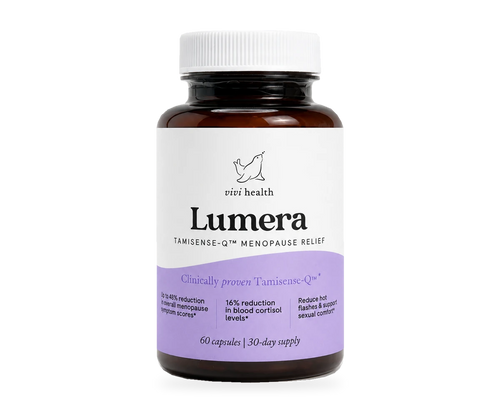
1 Bottle
4-week supply · $79/bottle
Common questions
What is Tamisense-Q™?
A complex of Korean thistle (Cirsium japonicum var. maackii) and thyme (Thymus vulgaris) extracts, developed in South Korea. It has been studied in four randomized, placebo-controlled 12-week trials with 305 women in total. In the 300mg trial, blood cortisol fell 16% and menopause symptom scores improved 48%.*
Is Lumera hormonal?
No. Lumera contains no hormones. In the 300mg Tamisense-Q™ trial, estradiol, progesterone, FSH and LH showed no significant change compared with placebo.*
How long until I notice a difference?
In the 2022 trial, symptom scores were about 31% better at week 4 and about 48% better at week 12. Results vary from person to person, so we suggest judging Lumera over 8 to 12 weeks of daily use.
Which option should I choose?
The 3-bottle, 12-week program matches the length of the studies, has the lowest price per bottle ($59 vs $79), and ships free.
Is this a subscription?
No. Every option on this page is a one-time purchase.
How does the 90-day guarantee work?
If Lumera isn't right for you, contact our team within 90 days of your order for a full refund.
Can I take Lumera with HRT or medication?
If you take HRT or other medication, or have a medical condition, talk to your healthcare provider before using Lumera.
How do I take Lumera?
Take 2 capsules daily with food, or as directed by your healthcare provider. Lumera is not intended for use during pregnancy or while nursing.
*These statements have not been evaluated by the Food and Drug Administration. This product is not intended to diagnose, treat, cure, or prevent any disease. Individual results vary. Clinical results shown are from research on the Tamisense-Q™ ingredient, not the finished Lumera product. Consult your physician before use if you are pregnant, nursing, have a medical condition, or take medications, including hormone therapy.
Customer testimonials reflect individual experiences and are shared with permission. Approximate placebo values are estimated from published figures. Percentages are rounded.
† Star rating is the average of ratings collected directly from Lumera customers.
References
- Avis NE, Crawford SL, Greendale G, et al. Duration of menopausal vasomotor symptoms over the menopause transition. JAMA Intern Med. 2015;175(4):531–539. doi:10.1001/jamainternmed.2014.8063
- Kravitz HM, Ganz PA, Bromberger J, et al. Sleep difficulty in women at midlife: a community survey of sleep and the menopausal transition. Menopause. 2003;10(1):19–28.
- Woods NF, Mitchell ES, Smith-DiJulio K. Cortisol levels during the menopausal transition and early postmenopause: observations from the Seattle Midlife Women's Health Study. Menopause. 2009;16(4):708–718. doi:10.1097/gme.0b013e318198d6b2
- Woods NF, Carr MC, Tao EY, Taylor HJ, Mitchell ES. Increased urinary cortisol levels during the menopausal transition. Menopause. 2006;13(2):212–221.
- Faubion SS, Enders F, Hedges MS, et al. Impact of menopause symptoms on women in the workplace. Mayo Clin Proc. 2023;98(6):833–845.
- The Menopause Society. Survey of OB/GYN residency program directors on menopause education. Menopause. Published online August 9, 2023.
- Noh YH, Hong J, Lee JW, et al. A complex of Cirsium japonicum var. maackii (Maxim.) Matsum. and Thymus vulgaris L. improves menopausal symptoms and supports healthy aging in women. J Med Food. 2022;25(3):281–292. doi:10.1089/jmf.2021.K.0127
- Noh YH, Kim DH, Lee SA, et al. The natural substance MS-10 improves and prevents menopausal symptoms, including colpoxerosis, in clinical research. J Med Food. 2016;19(3):228–237.
- Noh YH, Lee JW, Park J, et al. Natural substance MS-10 improves women's health via regulation of estrogen receptor. J Korean Soc Food Sci Nutr. 2016;45(6):903–910.
- Noh YH, Cheon S, Kim IH, et al. The effects of MS-10 dietary supplement, mixture of Korean thistle and thyme extracts, on bone health, and symptoms in menopausal women. J Funct Foods. 2019;52:680–689.
- Famenity Co., Ltd. Tamisense-Q™ for women's health: white paper (regulatory summary, clinical and preclinical data). MS-10 is the research name for Tamisense-Q™.
© Vivi Health · Refund Policy · Privacy · Terms